Data Sovereignty vs. Data Residency: What's the difference?
Blog | Data security

Cloud software, AI and international legislation are making organizations more aware than ever of how their data is handled. It's no longer just about where data is stored, but also which laws apply to that data.
As a result, the terms data sovereignty and data residency are becoming increasingly common. Although they are often used interchangeably, they refer to two fundamentally different concepts. In this article, we'll explain what they mean, how they differ, and why understanding that difference matters.
Also read: Europe, Wake Up: Trump Is Eating Your (AI) Data for Breakfast, where we explored digital sovereignty and Europe's growing dependence on foreign cloud and AI providers.
Data sovereignty and data residency: Two terms that are often confused
Data sovereignty and data residency are closely related, but they answer different questions:
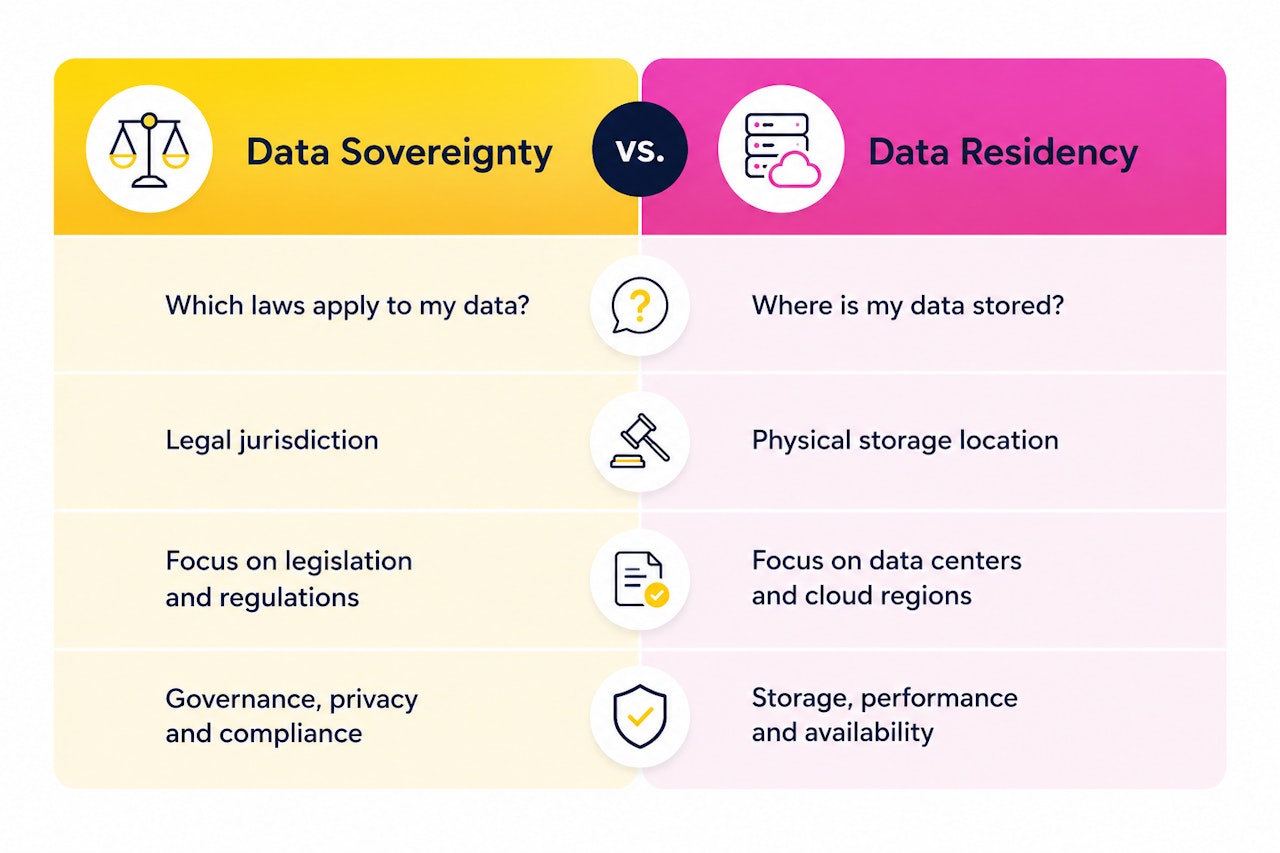
Data sovereignty: Which laws apply to my data?
Data residency: Where is my data physically stored?
The difference may seem small, but it's significant. An organization can store its data in a European data center while still being subject to foreign legislation. Likewise, the legal jurisdiction governing data does not automatically determine where that data is physically stored.
What Is data sovereignty?
Data sovereignty refers to the legal jurisdiction that applies to data. It determines which laws govern that data and, under certain circumstances, who may gain access to it.
Many organizations assume that data stored in a European data center automatically falls under European legislation. While that sounds logical, it isn't always the case.
Practical example
A Dutch organization uses software provided by a U.S.-based vendor. All customer data is stored in a data center located in Amsterdam.
From a data residency perspective, the data is stored in the Netherlands.
However, U.S. legislation such as the CLOUD Act may still apply. Under certain conditions, U.S. authorities can require the software provider to provide access to that data—even though it is physically stored in the Netherlands.
Data residency: Netherlands
Data sovereignty: United States
Why is data sovereignty important?
Data has become one of an organization's most valuable business assets. Personal information, financial records, internal communications, project documentation and business knowledge are all critical to daily operations.
When data is stored in the cloud, it's important to understand how it's protected and which legislation applies. That matters for privacy, compliance and trust.
So don't look at features alone. Also ask which laws apply to your data, who can access it, and how your software provider protects your information.
What is data residency?
While data sovereignty is about legislation, data residency is about the physical location of your data.
That could be a data center in the Netherlands, Germany or another cloud region.
For many organizations, this is an important selection criterion. They may require data to remain within Europe—or even within a specific country.
In short: Data residency answers one simple question: Where is my data stored?
Why is data residency important?
The physical location of your data affects compliance, performance and availability.
It's also worth remembering that cloud providers typically use multiple data centers for backups and disaster recovery. That's why you shouldn't only ask where your primary data is stored, but also where backup data is located.
An easy way to remember the difference
Although the two concepts are closely related, they answer different questions.
Why does this matter when choosing software?
More and more organizations process sensitive information in cloud software, including HR systems, CRM platforms, AI solutions, intranets and Learning Management Systems.
When selecting a software provider, it's wise to look beyond features and pricing.
Ask questions such as:
Where is our data stored?
Which legislation applies to our data?
Who can access our data?
How are backups managed?
Which certifications and security measures does the provider have?
Also read: Can we really trust AI with our data?
Conclusion
Technology is evolving rapidly and legislation is evolving with it. That's why it's important to understand not only what a software solution can do, but also how it protects your data.
Don't just ask software vendors where your data is stored. Also ask which laws apply to that data. Together, those answers provide a much clearer picture of how carefully a provider handles your information.
How does Fellow Digitals protect your data?
At Fellow Digitals, we believe organizations should know exactly where their data is stored and which legislation applies to it. That's why transparency, information security and compliance are built into everything we do.
In our Trust Center, you'll find detailed information about:
Data residency and hosting
Information security and certifications (ISO 27001, ISO 27701 and NEN 7510)
Privacy and GDPR compliance
AI and the European AI Act
Sub-processors and technical security measures
👉 Visit the Fellow Digitals Trust Center to discover how we help organizations manage their data securely, transparently and responsibly.

We love to share our knowledge with you
Related blogs