Nextcloud: Europe’s answer to Microsoft 365?
Blog | Digital Autonomy
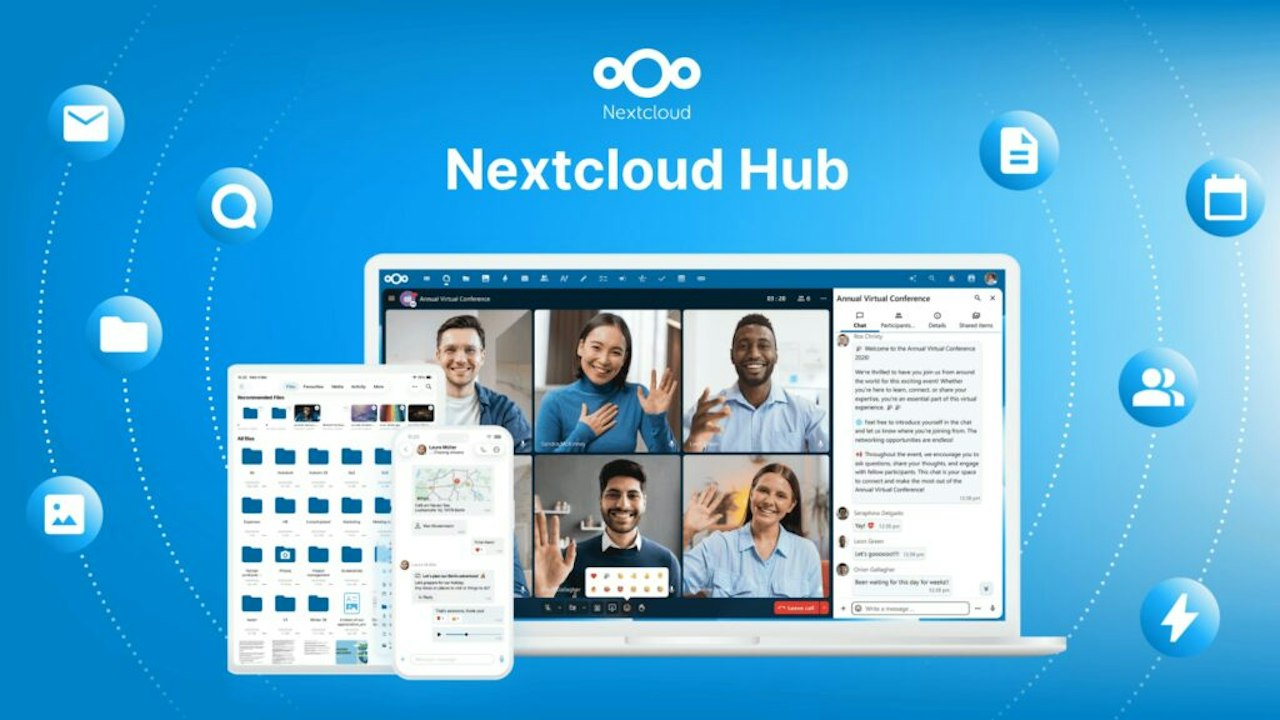
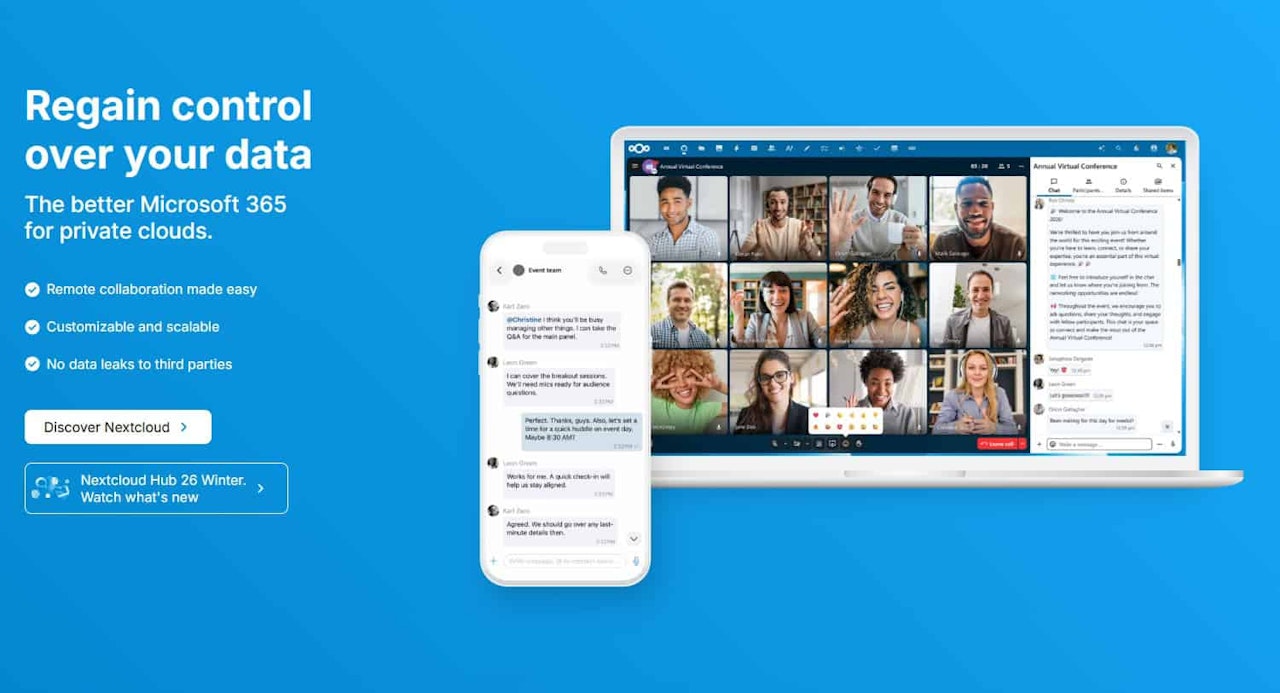
Nextcloud is increasingly being presented as the European alternative to Microsoft 365. The German open-source platform offers file storage, document editing, email, calendars, chat and video calls, many of the applications for which organisations currently depend on Microsoft. The key difference? Nextcloud can be hosted in a location and by a provider chosen by the organisation itself. This gives organisations greater control over their data, infrastructure and the jurisdiction under which that data falls.
That control is becoming increasingly important. European governments, schools, healthcare institutions and businesses rely heavily on technology from a small number of American providers. Our documents, communications, employee data and, increasingly, our AI applications are stored in ecosystems over which we have limited influence.
Jos Poortvliet, co-founder of Nextcloud, put it bluntly in an interview with Tweakers: if a company with around 160 employees and an open-source community is seen as Europe’s answer to American technology companies employing hundreds of thousands of people, then Europe has been “asleep at the wheel”.
A fundamentally different cloud model
Nextcloud is not a traditional cloud provider. It develops an open-source platform that organisations can host themselves or run through a hosting partner of their choice. Nextcloud mainly generates revenue through support and service contracts for larger organisations and public-sector bodies.
This model helps reduce dependence on a single provider. If a hosting partner no longer meets an organisation’s requirements, it can move its Nextcloud environment to another provider. For large volumes of data, this can be a complex operation, but the option remains available.
Even if Nextcloud itself were to disappear, the source code would remain available. The software is developed not only by the company, but also by an international community and commercial partners. Nextcloud therefore sees itself more as the facilitator of an ecosystem than the owner of a closed product.
Caught in the Microsoft 365 trap
This does not mean that Nextcloud can simply replace Microsoft 365 on a one-to-one basis. Microsoft has built an extensive ecosystem in which documents, user accounts, applications, metadata and workflows are closely interconnected.
In the interview, Poortvliet describes this as the “Microsoft 365 trap”. The deeper organisations become embedded in the ecosystem, the harder it is to leave. A migration usually starts with research and a proof of concept, followed by a pilot, procurement process and phased implementation. Such a transition can take years.
Nextcloud does not yet offer the same capabilities as Microsoft 365 in every area. The company acknowledges, for example, that further work is required to meet certain compliance requirements, such as retention periods and the demonstrably immutable storage of records.
European digital autonomy therefore does not call for uncritical enthusiasm for every European alternative. European and open-source solutions must also be assessed for security, continuity, functionality, usability and compliance.
Further reading on digital autonomy and trust
Data sovereignty versus data residency: what is the difference? Why the location of your data is only part of the story.
Europe, wake up: Trump is eating your AI data for breakfast About geopolitics, American technology companies and the vulnerability of European data.
We trust AI with our data. But how wise is that? What risks arise when organisations entrust sensitive information to AI systems?
Protect your digital workplace with multi-factor authentication A practical security measure that makes unauthorised access considerably more difficult.
More than storing data in Europe
Digital sovereignty is often reduced to the location where data is stored. But hosting data in a European data centre does not automatically make a solution European or sovereign. The owner of the technology may still be subject to non-European legislation. Subprocessors, technical integrations and AI services may also process data outside the preferred environment.
Organisations therefore need to look further. Who controls the infrastructure? Which legislation applies to the provider? Who can access the data? Which subprocessors are involved? Can we switch providers and take our information with us? And can we decide which AI models process our data?
Nextcloud, for example, offers an AI layer that allows organisations to choose the underlying language model. This could be an external model or a locally hosted open-source model. The choice remains with the organisation.
Fellow Digitals’ perspective on digital sovereignty
How does Fellow Digitals view digital sovereignty, European hosting and trust? We asked Rick Tigelaar, COO of Fellow Digitals.
How has Fellow Digitals organised control over data?
Rick: “Our solutions are built in Europe and hosted entirely within the European Union. We also work in accordance with internationally recognised standards, including ISO 27001, ISO 27701 and NEN 7510. In our Trust Center, we provide transparency about the security measures and controls we apply, the audits carried out and the subprocessors we work with.”
Are certifications and European hosting enough to build trust?
“No, they provide an important foundation, but trust requires more,” says Rick. “Organisations need to understand the choices a provider makes, the dependencies involved and how risks are managed. As a customer, you should not simply be told that your data is secure. You should also be able to see how that security is organised, monitored and continuously improved.”
Should organisations move away from American technology as quickly as possible?
“That would be too simplistic. Many organisations have become highly dependent on American platforms and cannot replace them overnight. But they do need to understand where their most important digital dependencies lie. Which data is business-critical? Where is it stored? Which providers and jurisdictions are involved? Can we switch if necessary? And do we ultimately retain sufficient control? Digital sovereignty begins with asking these questions.”
From vision to practice: Fellow Digitals integrates with Nextcloud
Fellow Digitals not only believes in the continued development of Nextcloud but has also developed an integration with the platform. But what does this integration deliver for organisations and their employees? CTO Marc Leidner explains:
“Fellow Intranet and Fellow LMS integrate with Nextcloud in a similar way to Microsoft 365. This includes access to documents, email and calendar integration, automated user provisioning and single sign-on. The integration is largely complete and is already running in a test environment. Together, Fellow Digitals and Nextcloud offer organisations a fully fledged, digitally sovereign European alternative to the well-known American platforms.”
Control begins with freedom of choice
Nextcloud cannot yet fully replace Microsoft 365 in every situation, but it demonstrates that serious European alternatives are possible. Fellow Digitals believes in this development and is bringing that vision closer to reality through its Nextcloud integration.

We love to share our knowledge with you
Related blogs